When Systems Fail
Emergency Preparedness for AmericanEuropean Households
Volume 1: The First 30 Days
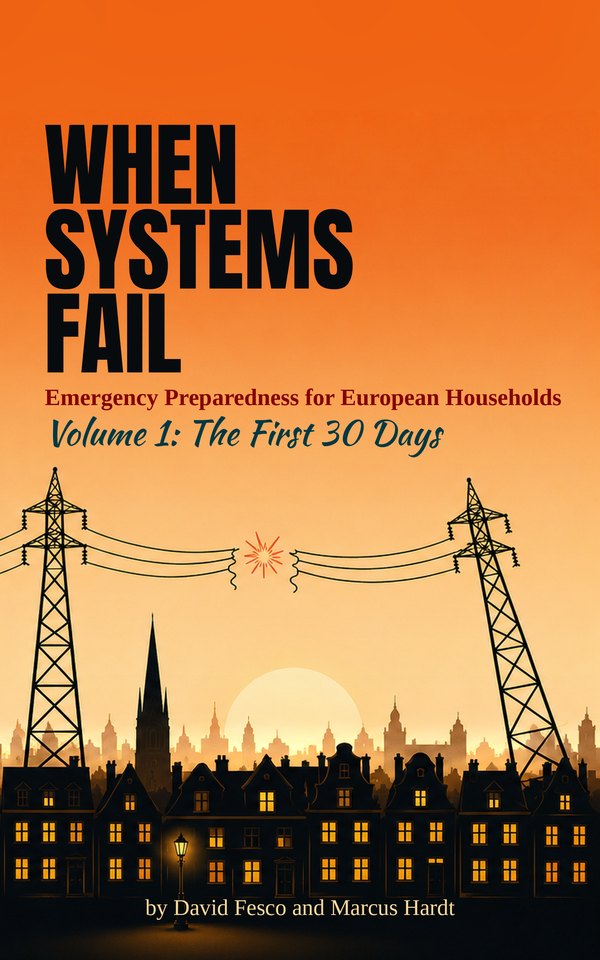
The power is out. The taps are dry. Your phone has no signal. What do you actually do in the next hour, the next day, the next month?
Most preparedness books are written for wilderness survivalists or bunker builders. This one is written for households: ordinary families in apartmentsflats and houses who want a calm, tested plan for when infrastructure fails.
- amazon.comUnited States edition
- amazon.co.ukUnited Kingdom and Europe editionKindlePaperback 26 Sep
- amazon.deGerman edition
- amazon.comUnited States edition
The links go straight to Amazon. Nothing is sold on this site, and it takes no payments.
Tell me when the next one is out
The German edition comes out on 5 October, and Volume 2 is in preparation. Leave your email and you get one message when each one goes on sale, with the direct link. You also join the Thursday Briefing, one calm email a week. Unsubscribe in one click, any time.
What the book is
Volume 1 is a practical household manual for the first 30 days of a real crisis: a blackout, a flood, a supply shock, a CBRN event, a pandemic or armed conflict. It covers the moment of impact, the month that follows, and what changes when the crisis is of a specific kind.
It is built on documented events rather than speculation: the siege of Sarajevo, Puerto Rico after Hurricane Maria in 2017, Texas during Winter Storm Uri in 2021, and Ukrainian cities under strikes on infrastructure since 2022. The Iberian blackout of 28 April 2025 is the baseline case the book is written around: no enemy, no warning, twenty three hours, no card payments and no trains. Every chapter ends with a summary and a working checklist. No gear worship and no doom.
What is inside
- The Psychology of Day Zero: your mind is the primary enemy
- Hard Inventory: resources here and now
- The Core Decision: stay or go
- Caught Outside: crisis while abroad or in transit
- Base Operations: managing a home without infrastructure
- Movement and the Outside World
- Psychological Hygiene and Group Organization
- Holding the Line: psychological resilience
- Medicine Without a Doctor: emergency level
- Civil Unrest, Mass Violence, and Internal Threats
- Chemical, Biological, Radiological and Nuclear (CBRN) Threats
- Pandemic and Biological Threats
- Natural Disasters
Who it is for
- Households that want a written plan instead of a stack of intentions.
- Parents responsible for children or elderly relatives.
- People who live in a city apartmentcity flat and have been told to store water, without ever being told how much or where.
- Anyone who has read the official four page leaflet and wanted the next four hundred.
What makes it different
- Written for a household, not for a wilderness or a bunker.
- Every dose, threshold and number carries a source, and the medical chapters follow published resuscitation and pharmacy guidance rather than folklore.
- Structured for decisions under stress: open the chapter you need, act, close it.
- US units, US utilities, US emergency numbers.Metric throughout, European hazards, European utilities, European emergency numbers. The two editions are separate books, not one book with a converted appendix.
Volume 2
Volume 2, Sustained Crisis, covers months 2 through 12, when stockpiles run out and short term reactions stop working: producing water and food, energy and heat off the grid, chronic care without a pharmacy, barter, household security, and the month six wall. It is in preparation and has no date yet. Subscribers hear first.
About the authors
Free on this site
Questions? Email hello@systemsfaillab.com