David Fesco and Marcus Hardt
Analysts of civilian system failure, and the authors of When Systems Fail. Their work looks at how ordinary households adapt when the systems they depend on stop working.
Their material draws on the Russia Ukraine war, the siege of Sarajevo, Puerto Rico after Hurricane Maria, and the long European migration shock. The question running through all of it is a narrow one: when civilian infrastructure breaks down, power, water, communication, supply, what do households actually do, and what works?
They came to that question from financial risk and decision making backgrounds. The frameworks that govern how institutions act under uncertainty turn out to govern how households act when sirens go off and the shelves empty. The difference is that institutions train for it and households do not.
Both write under the publisher Systems Fail Lab, which is also the organisation behind this site, the free Resilience Score, the Kit List builder and the Thursday Briefing.
How the work is sourced
Neither the site nor the book asks you to take a claim on trust. The method is the same in both:
- Every protocol starts from published guidance issued by a recognised institution: WHO, the Red Cross and Red Crescent movement, the Resuscitation Council and ERC, national civil protection authorities, ECDC, FEMA, CDC, NWS and NOAA.
- Every dose, threshold and number carries the source it came from, so a reader who wants to check it can.
- The narrative material is documented events rather than scenarios we invented: Sarajevo, Puerto Rico after Maria, Texas during Winter Storm Uri, the Iberian blackout of April 2025, Ukrainian cities under strikes on infrastructure.
- Where guidance is revised, the affected pages are updated and dated. Mistakes get corrected in public, not quietly.
The full version of this, including what we deliberately will not do, is on the How we work page.
On the use of AI
AI tools were used as an editor on this book: style, structure, consistency, and cleaning up the places where the argument was weak. They did not decide what goes in it. The content, the sources, the judgement calls and the errors are the authors'. The book took more than a year to write.
We say this in advance because it is easier than being asked.
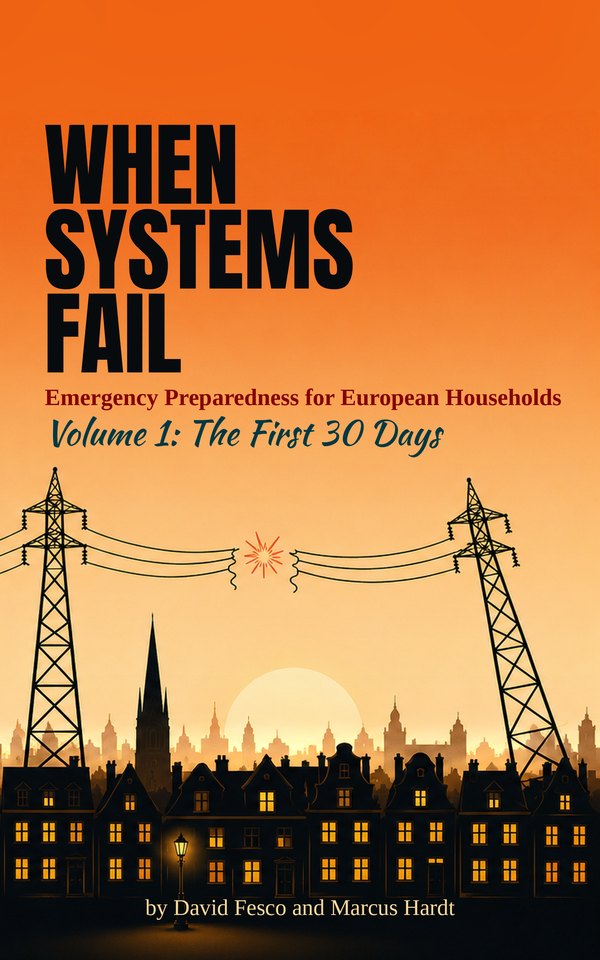
When Systems Fail, Volume 1
The first 30 days of a real crisis. Three parts, thirteen chapters, a checklist at the end of every one. On Amazon now.
See the book →